
Specialized 20ft & High-Profile Containers Ready for Direct Factory Export
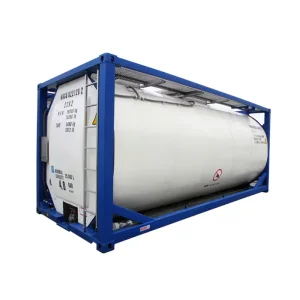
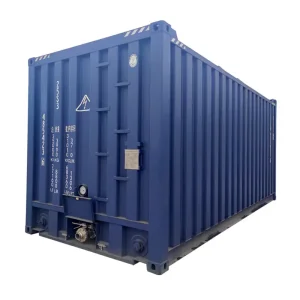
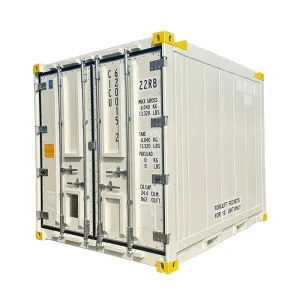
Direct factory sourcing for certified intermodal tanks, climate-controlled reefers, side-door dry units, and heavy offshore carriers with full Bureau Veritas (BV) and DNV maritime approvals.
The Strategic Economics of Buying 20 Ft High Containers from China
Navigating the structural transition from conventional 8'6" standard ISO boxes to 9'6" High-Cube configurations and specialized industrial shelters across modern supply chains.
Why Global Procurement Directors are Shifting to 20ft High-Cube Solutions
In the contemporary landscape of global freight distribution, energy project construction, and heavy industrial mining, capital efficiency hinges on volumetric optimization and dimensional versatility. The traditional 20-foot standard dry container (8ft 6in height) has long dominated dense, heavy bulk transport. However, international logistics planners, EPC contractors, and chemical infrastructure developers are aggressively shifting their procurement focus to 20 Ft High (9ft 6in High-Cube) configurations.
This extra foot of vertical clearance—elevating internal height from roughly 2.39 meters to 2.69 meters—solves critical physical roadblocks. It allows for the unhindered integration of overhead HVAC ducts, fire-suppression systems, heavy battery racking for Battery Energy Storage Systems (BESS), and standardized palletized stack heights that would otherwise necessitate an oversized, underfilled 40-foot unit. For overland rail corridors connecting Central Asia, the European hinterland, and African mining belts, the 20ft High-Cube platform provides the optimal balance of axle-load distribution and spatial efficiency.
Heavy-Gauge Engineering Specifications for 20ft High Enclosures
Detailed technical blueprints, Corten steel chemistry, door seal geometry, and corner casting load distribution compliant with ISO 1496-1 and maritime classification benchmarks.
| Dimensional / Mechanical Parameter | 20ft Standard Dry (20GP) | 20ft High-Cube Dry (20HC) | 20ft Dangerous Goods High-Cube | 20ft Offshore High-Cube (DNV 2.7-1) |
|---|---|---|---|---|
| External Dimensions (L × W × H) | 6,058 × 2,438 × 2,591 mm | 6,058 × 2,438 × 2,896 mm | 6,058 × 2,438 × 2,896 mm | 6,058 × 2,438 × 2,896 mm |
| Internal Clear Dimensions | 5,898 × 2,352 × 2,393 mm | 5,898 × 2,352 × 2,698 mm | 5,820 × 2,310 × 2,620 mm | 5,780 × 2,280 × 2,580 mm |
| Cubic Capacity | 33.2 m³ (1,172 cu.ft) | 37.4 m³ (1,320 cu.ft) | 35.2 m³ (With Sump) | 34.0 m³ (Reinforced) |
| Tare Weight (Base Build) | 2,200 kg (4,850 lbs) | 2,380 kg (5,247 lbs) | 2,850 kg (Bunded Floor) | 3,600 kg (Structural Heavy) |
| Max Payload Capacity | 28,280 kg | 28,100 kg | 27,630 kg | 21,400 kg (Dynamic Rated) |
| Primary Steel Grade | SPA-H / Corten-A (JIS G3125) | SPA-H Corten High Tensile | SPA-H + Epoxy Bund Lining | EN 10025-S355ML (Charpy Tested) |
| Flooring System | 28mm Marine Hardwood Plywood | 28mm Bamboo / Apitong Marine | Galvanized Grating + Spill Sump | 4.5mm Checker Steel Anti-Skid |
| Classification Certifications | ISO / CSC / BV | ISO / CSC / BV / ABS | CSC / EN 14470 / BV | DNV 2.7-1 / EN 12079 / Lloyd's |
Material Metallurgy & Structural Integrity Protocols
Every 20ft high-cube frame fabricated across our Tianjin and Suzhou production plants utilizes atmospheric corrosion-resistant SPA-H (Corten-A) structural alloy steel. The chemistry profile—enriched with controlled copper, chromium, and nickel percentages—induces the formation of a dense, self-passivating oxide layer upon atmospheric exposure. This chemical barrier prevents subsurface oxygen penetration, radically retarding pitting degradation when containers are exposed to aggressive maritime environments and heavy salt sprays during prolonged transoceanic voyages.
Critical structural load junctions, particularly the upper and lower corner castings manufactured to ISO 1161 standards, undergo automated sub-arc and robotic MIG welding. Finite Element Analysis (FEA) is utilized during initial engineering design to verify stress dispersal under excessive racking and stacking stresses. Containers are engineered to withstand continuous stacking up to 9-tiers high (loaded to maximum gross weight of 30,480 kg), accommodating severe vertical acceleration and cyclic torsional roll dynamics encountered on post-Panamax container vessels.
Tianjin & Suzhou Manufacturing Ecosystem: Efficiency and Lead Time Mastery
Strategic proximity to the world's premier seaport infrastructure combined with fully integrated upstream raw material supply clusters ensures unyielding lead times and rigorous cost discipline.
Integrated Upstream Steel Cluster
Direct pipeline agreements with top domestic mills (HBIS Group, Baosteel) guarantee batch consistency of SPA-H Corten coils, eliminating supply chokepoints and price volatility for high-volume procurement contracts.
Automated Shot-Blasting & Coating
Closed-loop, continuous SA 2.5 automated abrasive blasting removes mill scale before applying triple-tier marine coating systems (zinc-rich primer, epoxy intermediate, polyurethane topcoat) totaling over 120μm dry film thickness.
100 km Deep-Water Port Proximity
Production facilities situated within an hour of Tianjin Port and eastern maritime berths. This eliminates excessive inland drayage surcharges, allows agile one-way lease positioning, and ensures predictable export booking cycles.
Founded in 1983, CIMIC Group (Tianjin Cimic Imp&Exp Co., Ltd.) has engineered its operating posture around global logistics reliability. Unlike inland assembly workshops that face severe overland trucking expenses, bottlenecks at highway weight checkpoints, and volatile drayage rates, our Tianjin and Suzhou production centers are purposefully positioned within the primary maritime industrial belt.
This geographical positioning enables seamless intermodal handoffs. Containers pass through factory QA, obtain third-party Bureau Veritas or ABS CSC certification stamps on-site, and can be terminal-staged at the port within 24 hours of final inspection. Furthermore, our capability to load high-cube boxes with shipper-owned cargo (SOC status) or deliver empty units for international shipping line positioning minimizes the global customer's total landed cost per container (LCC).
Localized Application Scenarios for 20ft High Enclosures
From extreme-temperature mining operations to urban edge AI data centers and renewable microgrids, 20ft high-cube structures serve as the foundational building blocks for critical industries.
1. Hazardous Chemicals & Battery Storage (BESS)
Customized 20ft High-Cube Dangerous Goods enclosures equipped with explosion-proof exhaust louvers, integrated bunded floors (spill retention capacity > 1,200 liters), anti-static copper grounding networks, and automatic fire-suppression manifolds (Novec 1230 / FM200). Essential for Class 3, 6.1, 8, and Class 9 Lithium-ion battery installations.
2. Remote Mining & EPC Offshore Camps
Standard and high-cube 20ft units configured as insulated living quarters, mess halls, and water-treatment hubs. Fitted with mineral wool or polyurethane sandwich panels, integrated wiring conduits, and HVAC modules designed to withstand ambient desert temperatures exceeding +50°C in Western Australia or -40°C Siberian winters.
3. Edge Computing & Mobile Substation Shelters
The 9'6" clearance provides essential head space for overhead cable trays, pressurized air circulation chambers, and bottom raceways. These shelters host server racks for telecommunications nodes, mobile oil-field telemetry hubs, and high-voltage transformer gear with verified R-value thermal insulation.
4. Cold Chain & Controlled Atmosphere Pharma
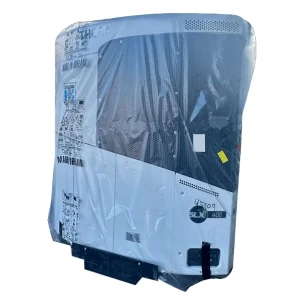
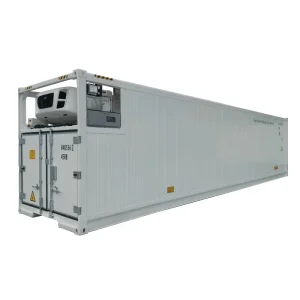
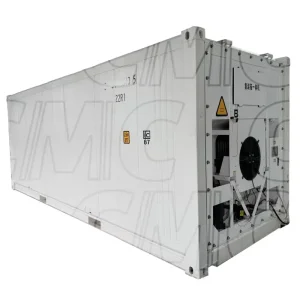
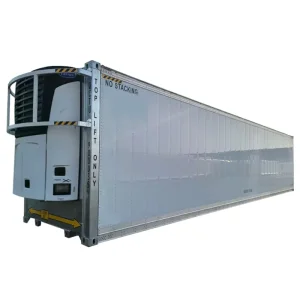
Equipped with Carrier Transicold, Thermo King, or Daikin refrigeration machinery. Integrated with stainless-steel interior cladding (Grade 304 food-grade), extruded aluminum T-bar floors, and computerized air-exchange valves, ensuring microclimate stability down to -35°C for high-value biologic drugs, fresh perishables, and seafood logistics.
5. DNV 2.7-1 Certified Offshore Wellhead Support
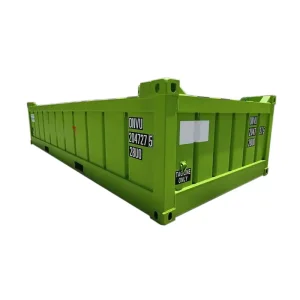
Engineered with certified pad eyes, four-part wire rope sling sets, and heavy structural hollow sections (RHS) built to absorb dynamic multi-axis shock loads during offshore crane operations on floating drilling platforms and FPSO support vessels in the North Sea and Gulf of Guinea.
Compliance Architecture, Maritime Approvals & Factory Audit Standards
How CIMIC structures third-party verification, non-destructive testing (NDT), and documented quality management systems to mitigate international procurement risks.
Global procurement failures in heavy steel containers typically originate from substandard base plates, porous structural welds, micro-fractured corner castings, and deficient surface preparation resulting in early corrosion under offshore conditions. At our manufacturing plants in Tianjin and Suzhou, quality assurance is codified into an unbroken 5-tier audit sequence:
Mill Spec & Chemistry Traceability
Every batch of Corten SPA-H steel arrives accompanied by EN 10204 3.1 chemical analysis and tensile test certificates. Incoming coils are spectrographically validated before cold roll-forming.
Ultrasonic & Magnetic Particle NDT
Critical structural load points—specifically top/bottom side rails and ISO corner casting fillet welds—undergo rigorous Ultrasonic Testing (UT) and Magnetic Particle Testing (MT) to identify internal slag or lack of fusion.
Pressure Decay & Light-Leakage Checks
Finished containers undergo high-intensity photometric light-leakage audits and continuous seal-integrity checks. Reefer and specialized units undergo pressurized air decay tests to establish thermal envelope airtightness.
Classification Surveyor Sign-Off
Resident surveyors from Bureau Veritas (BV), ABS, or DNV inspect structural tests (9-high stacking load tests up to 86,400 kg per corner post) and affix stamped CSC / DNV safety approval plates on-site.
The Next Decade of Specialized Container Innovation
How digital twin architectures, graphene-enhanced thermal barriers, and solar-integrated DC inverter power units are redefining the 20ft container ecosystem.
Satellite-Linked IoT Telematics
Next-generation 20ft high units are increasingly manufactured with factory-embedded NB-IoT and dual Iridium satellite transponders. Real-time telemetry tracks internal G-force shocks, door openings, cargo temperatures, VOC gas buildup, and battery health on dangerous goods units across deep sea voyages.
Graphene Aerogel Insulated Panels
Replacing traditional polyurethane foam, vacuum insulation panels (VIP) and graphene-augmented aerogel linings provide equivalent thermal resistance (R-values) at one-third the thickness. This expands internal usable space by up to 2.1 cubic meters while lowering thermal bridging losses.
Zero-Emission Hybrid Solar Cold Storage
Integrating thin-film flexible CIGS solar arrays directly onto the container roof ribs, paired with intelligent DC inverter cooling units. This enables remote off-grid operation for agricultural aggregation hubs and remote medical outposts without requiring continuous diesel generator run time.
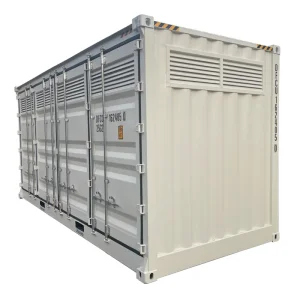
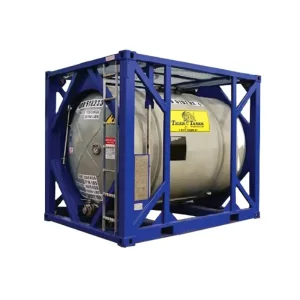
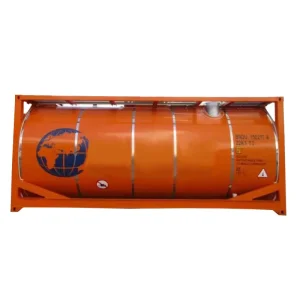
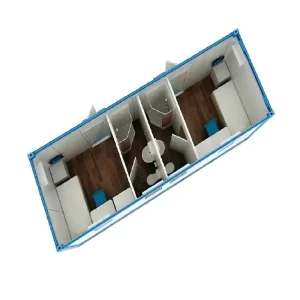
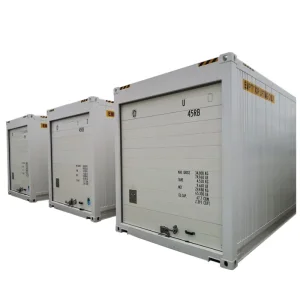
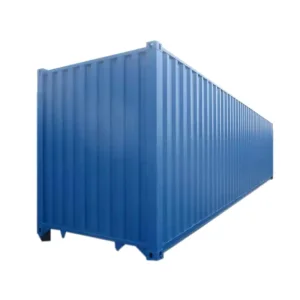
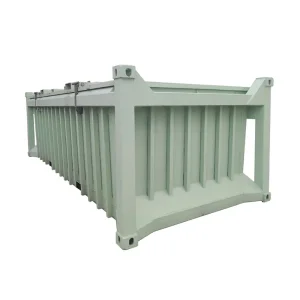
Specialized Modular, Hazardous Goods & Heavy Cargo Product Series
Immediate factory production slots and port-side stocks for specialized dangerous goods enclosures, 20ft/40ft modular buildings, liquid ISO tanks, and heavy bulk ore carriers.
Procurement, Compliance & Engineering Q&A
Technical answers covering structural parameters, ocean transport certifications, customization lead times, and port release procedures directly from our engineering team.
What is the exact dimensional difference between a standard 20ft container and a 20ft High-Cube container?
A standard 20ft dry freight container (20GP) has an external height of 8 feet 6 inches (2,591 mm), resulting in an internal usable height of roughly 7 feet 10 inches (2,393 mm) and a volumetric capacity of approximately 33.2 cubic meters. In contrast, a 20ft High-Cube container (20HC) stands at 9 feet 6 inches (2,896 mm) externally, providing an internal clear height of 8 feet 10 inches (2,698 mm) and a volumetric envelope of 37.4 cubic meters.
This yields an additional 4.2 cubic meters (~12.6% increase) of usable volume without changing the container's footprint (6,058 mm length by 2,438 mm width), making it the premier choice for equipment shelters, battery rooms, and voluminous general freight.
How does CIMIC ensure compliance with Bureau Veritas (BV) and CSC safety approvals?
Every production batch intended for international maritime transport undergoes mandatory prototype and routine type-testing witnessed by authorized classification society surveyors (e.g., Bureau Veritas, ABS, or CCS) in accordance with the International Convention for Safe Containers (CSC 1972) and ISO 1496-1.
Tests include 9-high stacking load tests (applying up to 86,400 kg per post), transverse racking tests, floor load endurance tests (utilizing axle test vehicles at 5,460 kg load), longitudinal inertia testing, and weatherproof water-tightness testing under high-pressure hose jets (100 kPa nozzle pressure). Each unit is fitted with a stainless-steel CSC data plate approved by the attending classification society.
Can 20ft High containers be engineered for Dangerous Goods (DG) Class 3 to Class 9 storage?
Yes. CIMIC specializes in OEM/ODM dangerous goods builds designed to meet European EN 14470-1 standards, Australian AS 1940 standards, and IMDG code requirements. Modifications include complete perimeter bunded floor systems with hot-dip galvanized removable grating, delivering over 1,200 liters of fluid catchment volume to contain accidental chemical spills.
Enclosures feature anti-sparking brass internal door handles, dual side-wall explosion-proof flame-arresting ventilation louvers, ceiling pressure-relief relief panels, emergency internal exit mechanisms, and bonded copper earth straps linked to every structural panel to prevent static discharge.
What are the key technical differences between standard ISO containers and DNV 2.7-1 offshore containers?
While standard ISO containers are designed for commercial maritime and intermodal rail transport where crane hooks grip corner castings under predictable vertical angles, offshore containers (built to DNV 2.7-1 / EN 12079 / ISO 10855) are engineered for the harsh dynamic forces encountered during open-sea vessel-to-rig transfers.
Offshore units use structural steel grades with verified Charpy V-notch impact toughness (e.g., S355ML steel tested at -20°C or -40°C), possess substantially heavier structural corner posts and top rails, omit traditional fragile corner castings in favor of thick certified lifting pad eyes, and are supplied with permanently certified 4-legged wire rope lifting slings incorporating master links.
What is the typical production lead time and minimum order quantity (MOQ) for custom 20ft High builds?
For standard 20ft High-Cube dry freight containers, our minimum order quantity is typically 1 to 5 units, with factory lead times ranging from 15 to 25 working days depending on ongoing production cycles. For deeply customized OEM/ODM projects (such as insulated reefer containers, side-door units, mobile generator trailers, or BESS enclosures), our engineering department completes detailed 3D CAD/SolidWorks structural submittals within 5 working days.
Upon drawing sign-off and material allocation, production typically requires 30 to 45 calendar days. Finished units can be released directly to Tianjin Port for immediate export vessel boarding.
How does CIMIC manage door layouts, insulation thicknesses, and refrigeration machine selection?
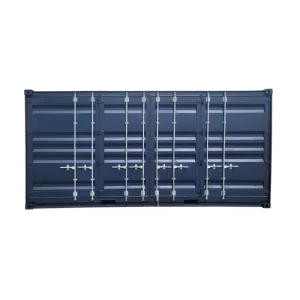
Our factory platform accommodates virtually any structural door architecture: standard double rear doors with 4 lock rods and EPDM multi-lip seals, full-length bi-folding side-open doors for side forklift pallet loading, or motorized insulated roll-up security shutters.
For temperature-controlled reefers and modular accommodations, insulation cores are configured using CFC-free high-density polyurethane foam (40–42 kg/m³) or structural rockwool (fire rating class A1) at thicknesses from 50mm up to 120mm. Customers have their choice of factory-installed primary refrigeration machinery: Carrier Transicold (ThinLINE, PrimeLINE), Thermo King (Magnum Plus), or Daikin (Zestia), with complete global warranty backing.
Initiate Your 20 Ft High Container Fleet Manufacturing Plan
Connect directly with CIMIC Group’s senior container engineering and export logistics team. Receive verified structural CAD drawings, classification testing certificates, and competitive FOB/CIF quotations within 24 hours.
Factory Technical Headquarters
Tianjin Cimic Imp&Exp Co., Ltd. (Est. 1983)
Huaying Building-1134, Central Avenue, Airport Economic Zone, Tianjin FTA Pilot Area, China
Primary Contact: +86 139 2048 2102 (Direct / WhatsApp)
Engineering Desk: [email protected]
Procurement Checklist for Rapid RFQ
- Exact height requirement: Standard 8'6" vs High-Cube 9'6"
- Floor configuration: Marine plywood, bamboo, check plate, or bunded sump
- Door configuration: Standard end-door, side-open, or roll-up shutter
- Certifications required: Standard ISO CSC, BV, ABS, or DNV 2.7-1
- Target delivery port and shipping status (SOC empty or one-way cargo loaded)